

Portsmouth Concrete
The difference between concrete that lasts and concrete that starts cracking, settling, or flaking early usually isn't the finish you see on day one. It's the prep you don't see: the base, the compaction, the reinforcement, the joints, and the cure. In Portsmouth, concrete has to handle heavy rain, shifting soil, and moisture that finds its way under slabs and along edges. If those details are rushed to hit a low bid, you pay for it later in trip hazards, drainage problems, and repairs that never quite blend in.
757 Fence & Deck installs and replaces concrete in Portsmouth for homeowners and commercial property managers who want a clean, solid surface that holds grade, sheds water the right way, and looks right next to the building. We're licensed and insured, and we provide free estimates. Financing is also available for larger scopes.
Concrete work that lasts in Portsmouth
Concrete is a mixture of cement, water, and aggregates (stone and sand). Once placed and cured, it becomes a dense slab that can carry foot traffic, vehicles, and outdoor furniture. The catch is that concrete is strong in compression but it still moves with temperature, moisture, and what the soil underneath is doing. That's why the "invisible" parts of the job matter so much.
For concrete in Portsmouth, we pay close attention to:
- Water management: Proper slope and edge control so runoff doesn't pond against the slab, leak toward the foundation, or wash out the base.
- Subgrade stability: Removing soft material and building a compacted base that won't settle after the first season of weather.
- Crack control: Planning joints and reinforcement so cracking happens where it's supposed to, not across the middle of the pad.
- Surface durability: Finishes and curing practices that reduce dusting and surface scaling, especially where de-icing products or salt exposure are part of life.
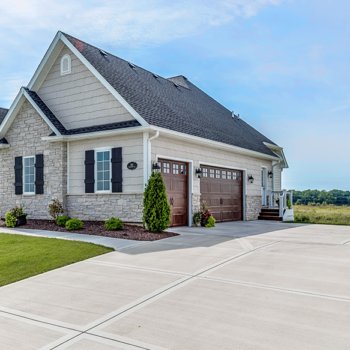
Common concrete projects include driveways, walkways, patios, pads for sheds or equipment, and small slabs for trash enclosures or outdoor work areas. For commercial properties, we also handle concrete improvements for commercial properties that need clean edges, safe transitions, and surfaces that can take repeated use.
How we build a slab, driveway, or patio that won't fail early
Every site is a little different, so we start by looking at grade, drainage, access, and how the slab will be used. A driveway needs different thickness and reinforcement than a walkway. A patio that will hold a future pergola or hot tub needs planning before the concrete truck arrives.
Our concrete process in Portsmouth typically includes:
- Layout, elevations, and drainage plan: We confirm where the surface starts and ends, set slope so water runs away from structures, and identify where downspouts or existing drainage affect the pour.
- Excavation and base prep: We remove unsuitable material, then install a compactable base and compact it in lifts. Skipping compaction is a common reason concrete settles and cracks at corners and edges.
- Forming and edge control: Forms set the final shape and thickness. Straight lines and consistent edges matter on driveways and walkways, especially where new concrete meets existing asphalt, concrete, or the garage slab.
- Reinforcement: Depending on the application, we use reinforcement such as rebar or wire reinforcement and place it correctly so it's actually inside the slab where it helps. Reinforcement can't "fix" a bad base, but it helps control crack width and keeps panels working together.
- Placement and finishing: We place the mix, consolidate where needed, and finish to match the use. A too-smooth finish outdoors can be slick when wet, while a broom finish offers traction for walkways and patios.
- Joints cut or tooled at the right time: Concrete shrinks as it cures. Control joints give it a planned place to crack so you don't get random breaks across the field. Joint spacing and layout aren't guesswork; they're part of making the slab behave.
- Curing and protection: The cure is where strength and surface durability develop. Rushing this step is how you end up with a weak, dusty surface. We give clear guidance on foot traffic, moving furniture back, and when vehicles can return.
One practical example: if a driveway replacement is poured without correcting the grade at the garage approach, water can run toward the slab and the garage door. That often turns into stains, ice in cold snaps, and a slick transition. Getting the pitch right during forming prevents a problem you'd otherwise notice every time it rains.
Stamped and decorative concrete for patios and entries
If you want more than a plain gray slab, stamped and decorative concrete can add pattern and color while still giving you a monolithic surface that's easy to hose off and maintain. We install stamped/decorative concrete in Portsmouth for patios, front entries, and outdoor living areas where appearance matters as much as function.
Decorative work succeeds or fails on planning. Before we stamp, we confirm:
- Pattern direction and borders: So the stamp layout looks intentional and doesn't end with awkward partial impressions at edges or steps.
- Color approach: Integral color, color hardener, or accents, based on the look you want and how the space will be used.
- Slip resistance: Especially for pool-adjacent patios, shaded areas that stay damp, and entries that see frequent wet shoes.
- Sealer expectations: Sealers help with stain resistance and color depth, but they also need the right prep and recoat schedule. We'll tell you what to expect so the surface doesn't get neglected until it looks tired.
Stamped concrete is also less forgiving of rushed timing. The mix, temperature, and finishing schedule all affect stamp quality and consistency. That's why we treat decorative pours as a separate plan, not "the same slab with a pattern."
What to check before you approve a concrete pour
Concrete is permanent enough that small shortcuts turn into long-term headaches. If you're comparing proposals for concrete in Portsmouth, these are the decision points that actually predict results:
- Drainage and slope details: You should hear exactly where water will go. "It'll drain" isn't a plan.
- Base thickness and compaction approach: A stable base is what keeps the slab from rocking, settling, and breaking at corners.
- Reinforcement type and placement: Ask what's being used and how it will be supported so it ends up inside the slab, not lying on the ground.
- Joint layout: Control joints should be placed to break the slab into sensible panels, not randomly added after the fact.
- Finish matched to use: Driveways, patios, and walkways don't all need the same finish. A good contractor will explain why.
Also pay attention to warning signs during the conversation. If no one asks about how you use the area, where water currently goes, or whether vehicles will turn in place, the scope is probably being treated as a generic pour. That's how you get a driveway that looks fine until you see tire scuffs, low spots, and edge breakage in the first year.
We keep estimates straightforward and tied to the site conditions we can see. If you're considering a larger outdoor upgrade, financing options can help you complete the full scope instead of piecemealing work that should be graded and poured as a unit.
Concrete questions in Portsmouth (FAQ)
How long do I need to stay off new concrete?
Foot traffic is usually allowed sooner than vehicle traffic, but the right timing depends on the mix, thickness, and site conditions. We'll give you clear, job-specific guidance at the end of the pour so you don't leave marks, chip edges, or weaken the surface during the cure.
Should I replace my concrete or can it be repaired?
Hairline cracking is common, but uneven panels, widespread settlement, and broken edges often point to base or drainage issues that repairs won't solve. If the slab is no longer safe or holds water in the wrong places, replacement is usually the cleaner, longer-lasting fix.
What finish is best for an outdoor walkway or patio?
For most outdoor walking surfaces, a broom finish gives reliable traction in wet weather. Decorative finishes can work well too, but they should be chosen with slip resistance and maintenance in mind, especially in shaded areas that stay damp.
Will stamped concrete require special maintenance?
Stamped concrete benefits from periodic cleaning and resealing to protect color and improve stain resistance. We'll explain what products to avoid, what "normal" wear looks like, and how to keep the surface looking consistent.
Can you pour concrete for residential and commercial properties?
Yes. We handle concrete installations for both residential and commercial needs in Portsmouth, with the slab design, reinforcement, and finish matched to how the space will be used.
If you want concrete that stays level, drains correctly, and looks right next to your home or building, start with a free estimate. Share what you're building and how you plan to use the space, and we'll recommend a slab design that fits the site instead of forcing a one-size approach.
Request a free estimate and we'll schedule a time to look at the grade, drainage, access, and finish options for your Portsmouth property.


